How to Fix Cigar Burn and Draw Problems: Complete Guide
Every handmade cigar is built by human hands out of natural leaves that vary in thickness, moisture and vein structure. Even inside a box from a top factory in Havana, Santiago or Estelí, you will occasionally encounter a cigar that draws like a pinched straw, burns down one side like a canoe, splits its wrapper mid-smoke, or turns bitter in the final third.
Most smokers respond to a misbehaving cigar by puffing harder and faster. That almost always makes the problem worse. Nearly every burn or draw failure has a mechanical cause, either in how the cigar was stored, how the cap was opened, or how fast air is being pulled through the coal, and almost all of them can be fixed in the chair if you catch them early.
Quick diagnostic chart: symptom, cause and immediate fix
| Symptom | Primary Cause | Immediate Fix in the Chair | Prevention for Next Time |
|---|---|---|---|
| Tight / plugged draw | Over-humidified bunch, narrow cut, or twisted filler knot under the band | Re-cut slightly deeper; roll the knot gently between thumb and forefinger; use a fluted draw tool | Lower humidor RH to 64–66% (especially for Cuban cigars) |
| Loose / wind-tunnel draw | Under-filled bunch or dry, shrunken filler leaves | Take shorter, slower sips; use a punch cutter next time to restrict airflow | Check humidor seal and keep RH at 66–69% |
| Canoeing (one side burns fast) | Uneven lighting, wind/air conditioning draft, or thick wrapper vein on the slow side | Rotate the slow-burning side to the bottom; touch up the unburned lip with a jet flame | Toast the entire rim of the foot evenly before taking your first puff |
| Tunneling (core burns, wrapper stays unlit) | Smoking too slowly with a thick/oily or damp wrapper | Touch up the outer wrapper ring and take slightly firmer puffs for two minutes | Dry-box oily Maduro cigars for 12–24 hours before smoking |
| Coning (wrapper burns faster than core) | Puffing too fast and hard, pulling oxygen strictly across the outside leaf | Set the cigar down for 90 seconds so the coal cools and levels out | Slow down to one puff every 45–60 seconds |
| Cracked or splitting wrapper | Dull cutter, swollen damp filler inside a dry wrapper, or sudden temperature shock | Dab a tiny drop of pectin or moisture on the end of the crack to stop it running; keep the band on | Use a sharp double-blade cutter and acclimate the cigar before going outdoors |
| Harsh, hot or bitter taste | Overheating from rapid puffing, or tar accumulation at a tiny cut aperture | Tap off the ash, purge by blowing out gently, let it cool, and re-clip 1 mm off the head | Widen your cut and slow your cadence |
1. Fixing a plugged or tight cigar draw
Nothing ruins an evening faster than lighting a prized cigar only to find you have to pull with your cheeks just to get a wisp of smoke. Before you reach for any tool, work through these steps from least invasive to most direct.
Step 1: Test the cold draw before lighting, and widen the cut if needed
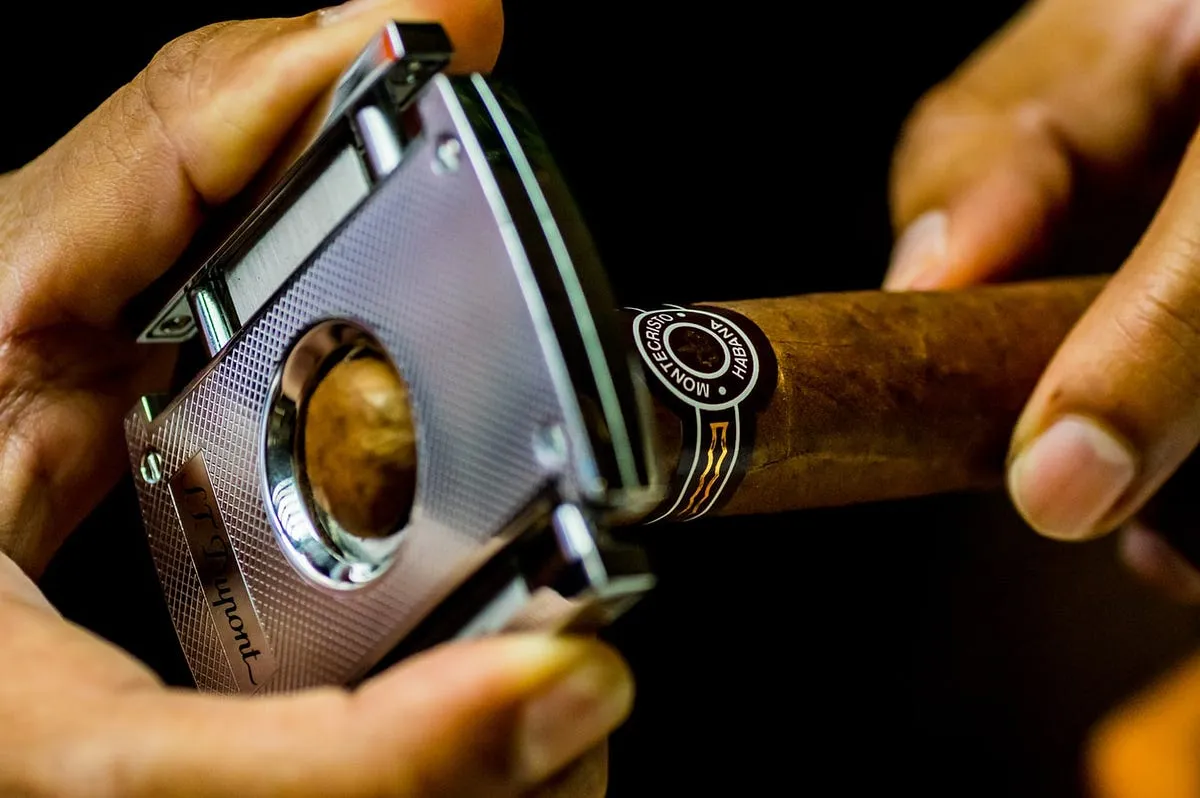
Always test the airflow before putting flame to the foot, as we recommend in our guide on how to cut and light a cigar. If you used a punch cutter (such as the S.T. Dupont Double Puncher) and the draw feels tight, make a second overlapping punch to form a figure-eight opening, or switch to a straight double-guillotine cut just above the cap line. On a tapered Belicoso or Torpedo, take a second 2-millimetre slice down the cone.
Step 2: Find and massage the knot
Run your thumb and index finger gently down the length of the cigar. Nine times out of ten, a plugged cigar is not packed tightly from foot to head; instead, the buncher twisted the leaves slightly at one specific pinch point, almost always right under the band or an inch below the cap.
Once you feel that hard spot, wait until you have smoked a few minutes so the warm smoke softens the internal leaves, then gently roll that section between your thumb and forefinger. Do not squeeze hard enough to crack the dry wrapper; a gentle quarter-turn roll is often enough to open an air channel between compressed leaves.
Step 3: Why toothpicks fail (and how a real draw tool works)
Stabbing a wooden toothpick or a skewer down the head of a cigar compresses the tobacco sideways, compacting the surrounding filler even tighter and often splitting the cap. A proper cigar draw tool is a slender, fluted steel rod with tiny upward-facing barbs that actually extracts a thin thread of packed stem or leaf when pulled back out, creating a clean breathing channel without bursting the binder.
Step 4: The real culprit is usually 70%+ humidity
If more than one cigar in a box draws tight, the roller is rarely to blame. Tobacco is hygroscopic: at 72 percent relative humidity, the filler leaves inside the bunch swell and close off the microscopic air channels between them. Dropping your storage environment to 64 to 66 percent relative humidity (see our humidor and humidity guide) resolves the vast majority of tight draws in both Cuban and thick-ring-gauge New World cigars.
2. Fixing uneven burns: canoeing, tunneling and coning
A handmade cigar does not need a laser-flat burn line every minute of the smoke. Minor waves of three or four millimetres self-correct naturally as the coal hits thinner leaf. Step in only when an uneven burn extends past roughly half a centimetre.
The rotation rule: put the slow-burning side on the bottom
Many smokers instinctively hold a canoeing cigar with the unburned strip of wrapper on top, thinking heat rises. In fact, the top side of a horizontal cigar loses heat upward into the room, while the bottom side gets the freshest draft of rising oxygen as you draw. Rotating your cigar so the unburned lip sits at the 6 o’clock position helps the slow side catch up on its own.
Canoeing (one side races ahead)
Canoeing starts for one of three reasons: you missed one edge of the rim when lighting the foot, you are sitting in a cross-breeze (an open window or ceiling fan will always accelerate the windward side), or the slow-burning side contains a thicker structural vein.
- The fix: Rotate the unburned side to the bottom, slow your puffing rate, and use a single-flame jet lighter such as the S.T. Dupont Défi Extrême to kiss only the leading edge of the unburned wrapper until it glows and drops into line with the rest of the coal.
Tunneling (the inside burns while the wrapper goes out)
You can spot tunneling when the ash looks hollow, smoke output drops, and the outer wrapper remains uncharred several millimetres behind the internal ember. Tunneling happens when a thick, oily Maduro or Broadleaf wrapper is too damp to burn at the same speed as the drier filler core, or when you leave the cigar resting in the ashtray for three or four minutes between puffs.
- The fix: Tap off the loose ash, use a precision torch from our S.T. Dupont lighters collection to burn back the overhanging sleeve of unlit wrapper until it is flush with the inner coal, and take slightly fuller puffs every 40 seconds so heat radiates outward to the wrapper.
Coning (the wrapper burns faster than the filler)
When you tap off the ash and see a long, sharp cone of glowing filler sticking out like a sharpened pencil, you are puffing too hard and too fast. Because oxygen enters easiest around the outer perimeter of the cigar, aggressive drawing turns the wrapper and binder into a blowtorch while starving the dense ligero leaves at the centre of the bunch.
- The fix: Put the cigar down for a full minute or two. Let the outer ring cool while the heat equalises into the core.
3. Stopping and repairing cracked or unravelling wrappers
A split wrapper leaks air ahead of the coal, ruining the draw and starving the burning foot of suction. Where the split occurs tells you immediately what caused it:
- At the head (cap unravelling): You cut below the shoulder line where the cap ends and the spiral wrapper leaf begins. Keep a small bottle of flavourless natural fruit pectin (or in an emergency, touch the moistened tip of your finger or a dab of honey from the bar) to glue down the loose edge before the entire spiral unwraps.
- In the middle of the barrel: Either the cigar was dropped, or the filler inside expanded faster than the dry outer wrapper could stretch. Leave the cigar band on for as long as possible; the band acts as a splint holding the split closed until the burn line reaches it.
- At the foot right after lighting: Temperature and humidity shock. Taking a cigar stored at 18°C and 68% RH straight onto a freezing winter terrace or into dry, baking summer sun causes the outer leaf to contract while the hot coal expands the foot. Always let your cigar sit out on a tray for 20 to 30 minutes to adjust to ambient conditions before lighting.
4. Why cigars turn bitter or keep going out (and how to purge)
If a cigar tastes pleasant for the first half and then suddenly turns acrid, metallic or sour in the final third, you are tasting condensed tars and superheated steam.
Every time you draw hot smoke through the unburned barrel of the cigar, the tobacco acts as a filter, trapping moisture, nicotine oils and heavy combustion tars near the head. Two habits accelerate that build-up:
- Puffing faster than once every 45 seconds, which drives coal temperatures from a gentle smoulder (~400°C) toward an incandescent glow (~700°C) that chars sugars into bitter carbon.
- Cutting too small an opening, which forces all the hot smoke through a tiny pinhole, concentrating dark, bitter tar right where your tongue touches the head.
How to purge and refresh a cigar mid-smoke
Whenever a cigar starts tasting heavy, flat or slightly bitter, or whenever you need to relight a cigar that has gone out in the ashtray, perform a cold purge:
- Gently tap all loose, grey ash off the foot into the ashtray (never stub the foot).
- Place the cigar to your lips and blow gently outward through the barrel for three to four seconds. You will see a plume of stale grey smoke exit the foot, pushing trapped moisture and ammonia away from the head rather than pulling it into your mouth.
- If tar has visibly darkened the cut opening, use your cutter to shave a clean 1-to-2 millimetre slice off the head, exposing fresh, dry tobacco.
- Let the cigar rest for 60 seconds, toast the foot briefly if needed, and resume at a slow, unhurried pace.
The habit that solves 90 percent of cigar problems: dry-boxing
If you live in a damp climate or keep a desktop humidor at 69 to 72 percent relative humidity, the single most effective step you can take before lighting a thick Maduro or a tightly bunched Habano is dry-boxing.
Take the cigar you plan to smoke tomorrow out of your humidor today and lay it inside an empty, un-humidified cedar cigar box (or on a tray in a cool cupboard) for 12 to 24 hours. That brief rest allows excess surface moisture in the wrapper and outer binder to evaporate while the core stays resilient. The result is an effortless draw, a razor-straight burn line, and cleaner, sweeter flavour from the first puff to the band.
Frequently asked questions
How do you fix a plugged or tight cigar draw?
First check that your cut is wide enough; if you used a punch or V-cutter, make a straight guillotine cut just above the shoulder line. Next, gently roll the cigar between your fingers where you feel a hard knot below the band. If it stays blocked, use a dedicated spiral draw tool rather than a toothpick, and store future boxes at 64 to 66 percent relative humidity.
What is the difference between cigar canoeing and tunneling?
Canoeing happens when one side of the wrapper burns much faster than the other, leaving a long boat-shaped lip of unburned leaf. Tunneling happens when the inner filler burns away while the outer wrapper fails to combust, usually because the wrapper is too damp or very oily.
Why does my cigar taste bitter or acrid in the last third?
Bitterness comes from puffing too frequently or drawing through a narrow cut, both of which overheat the tobacco and condense heavy tars at the head. Slow your cadence to one gentle puff every 45 to 60 seconds, purge the cigar by blowing gently through it, and clip a fresh millimetre off the head if tar has built up.
Why does my cigar wrapper crack or split while smoking?
If the wrapper splits near the foot or middle while you smoke, the filler inside is damp while the wrapper is dry, or you have taken a cold cigar from a humidor straight into hot or freezing outdoor air. Let your cigar acclimate outside the humidor for 30 minutes before lighting.
What does purging a cigar mean and when should you do it?
Purging means blowing gently outward through the lit cigar for three to four seconds after tapping off old ash. It expels stale smoke, ammonia and trapped moisture from the filler tunnel, refreshing the flavour in the second half or right before relighting.
Keep reading
Cuban Cigar Box Codes, Factory Stamps and Ageing Guide
Learn how to read Cuban cigar box date stamps and factory codes (like MAR), spot the sick period, and compare Edicion Limitada, Re…
Read article →
How to Store Cigars: Humidor Setup, Humidity and Long-Term Care
A practical guide to storing cigars properly: the right humidity and temperature, choosing and seasoning a humidor, using two-way …
Read article →
S.T. Dupont Heritage: The Gold Standard of Luxury Cigar Lighters and Cutters
Discover the 150-year heritage of S.T. Dupont in Faverges, France: from royal leather goods to the iconic Ligne 2 'Cling' sound an…
Read article →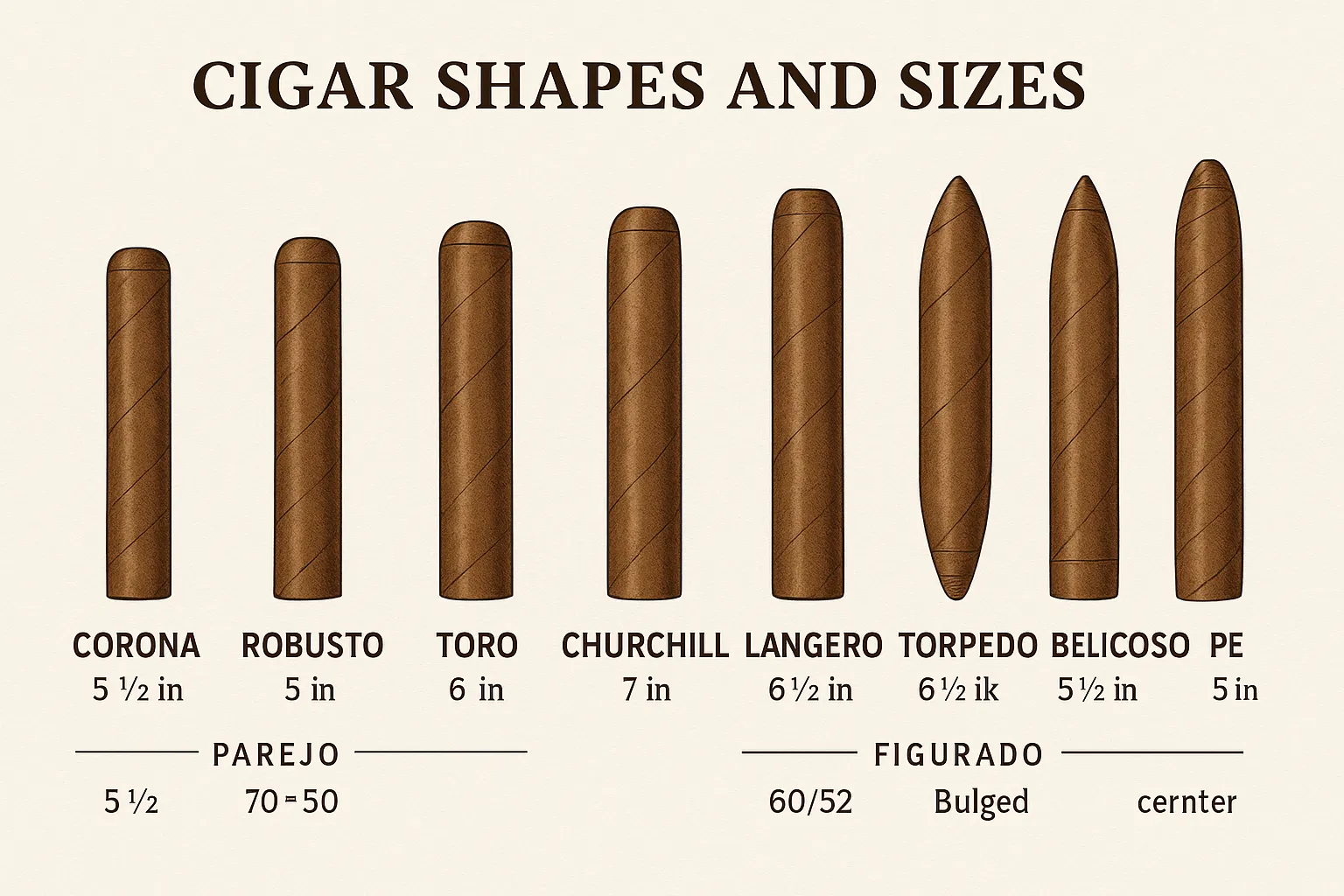
Cigar Sizes and Shapes Chart: Vitolas and Ring Gauge Guide
Complete cigar sizes and shapes chart explaining ring gauge, Parejo vs Figurado vitolas, and how Robusto, Toro, Corona, Churchill …
Read article →